
Date/Time
Date(s) - 10/12/2025
08:30 - 09:45
Location
Press Club Brussels Europe
Categories
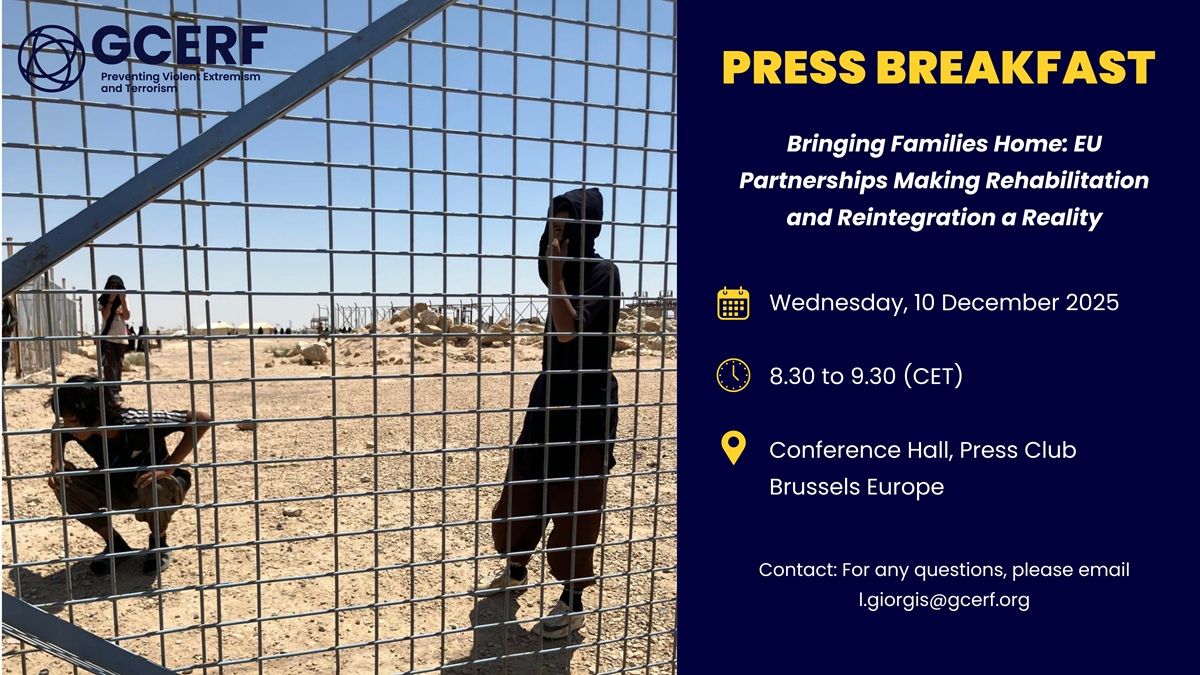
Bringing Families Home: EU Partnerships Making Rehabilitation and Reintegration a Reality
Around 26,500 people, mostly children, remain in the Al Hol and Al Roj camps in northeast Syria. Without structured repatriation, rehabilitation, and reintegration, they risk becoming the next generation of terrorists. GCERF, with EU support, has already helped over 8,600 returnees safely reintegrate and is expanding programmes to Tajikistan and Uzbekistan, alongside implementing the Global Rehabilitation and Reintegration Mechanism (GRRM) – a key step toward closing the camps and breaking the cycle of violence. The EU’s leadership is vital to safeguard security, uphold humanitarian standards, and strengthen strategic influence in a fragile region.
Speakers*
- Mr Stefano Manservisi, Former Director-General for International Cooperation and Development (DEVCO) at the European Commission and GCERF Chair of the Governing Board
- Dr Khalid Koser, GCERF Executive Director
- Dr Lilla Schumicky-Logan, GCERF Deputy Executive Director & Head of Portfolio Management
- H.E. Xhelal Sveçla, Kosovo Minister of Interior
About GCERF
The Global Community Engagement and Resilience Fund (GCERF) is the only global fund for preventing violent extremism and terrorism. Over the last ten years, GCERF has invested USD 250m in community-based organisations in 25 countries, providing better alternatives for young people at risk of radicalisation and recruitment, at an average cost of USD 30 per person. GCERF’s multilateral Governing Board is chaired by Mr. Stefano Manservisi. Learn more here: https://www.gcerf.org/
Background
A generation at risk – Around 26,500 people, including 6,500 foreigners, remain in the Al Hol and Al Roj camps in northeast Syria, 80% of them children. Deprived of education, opportunity, and hope, these young people risk becoming the next generation of terrorists without structured repatriation, rehabilitation, and reintegration.
Proven impact – GCERF-supported partners have helped over 8,600 returnees rehabilitate and reintegrate safely across the Western Balkans, Iraq, Syria, and Kyrgyzstan – with no known cases of recidivism.
Regional leadership – The Western Balkans are leading the way. Kosovo alone has safely repatriated around 160 women and children, providing a model for other countries. In Kyrgyzstan, more than 500 people have returned, with GCERF currently supporting 140 women and planning support for 250 women and children.
Global expansion – With support from the EU, GCERF will soon launch rehabilitation and reintegration support in Tajikistan and Uzbekistan, strengthening safe and sustainable return systems in key regions.
New mechanism for impact – At last week’s Global Coalition against Daesh Core Focus Group meeting in Abu Dhabi – supported by the EU, Germany, and the USA – the EU, the Netherlands, Norway, and Sweden confirmed their support for GCERF to implement the Global Rehabilitation and Reintegration Mechanism (GRRM), a key step toward closing camps in northeast Syria and breaking the cycle of violence.
EU as key partner – The EU was GCERF’s largest financial partner last year. It supported programmes across Iraq and the Western Balkans and is currently supporting a joint initiative in Central Asia that focuses on the prosecution, rehabilitation, and reintegration of returnees from northeast Syria.
EU leadership matters – The EU has both the credibility and the responsibility to lead on structured and dignified rehabilitation and reintegration – safeguarding European security, upholding humanitarian standards, and strengthening its strategic influence in a fragile region.