
Date/Time
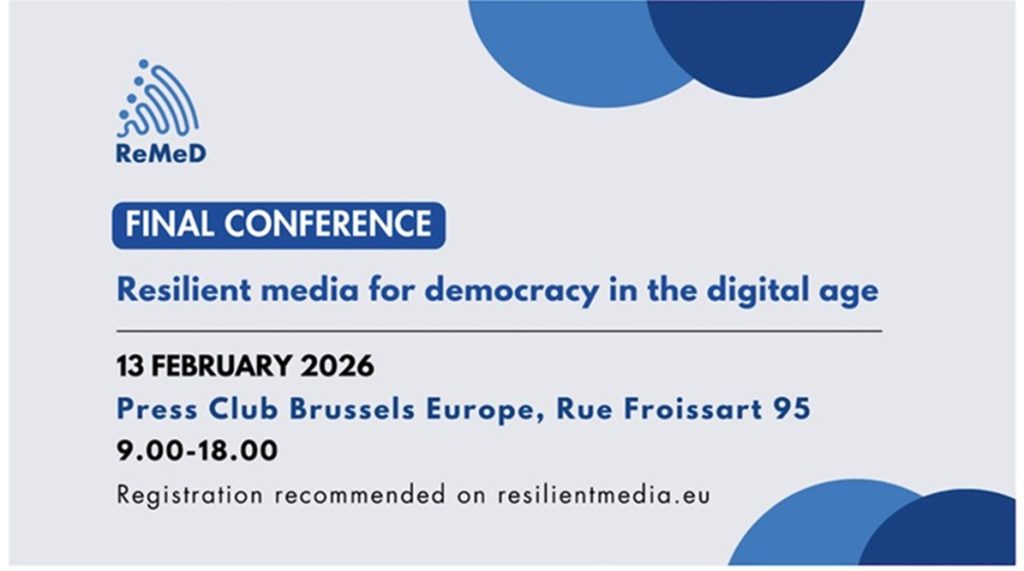
Date(s) - 13/02/2026
09:00 - 18:00
Location
Press Club Brussels Europe
Categories
9:00-9:15 Participants arrival and registration
9:15- 9:30 Opening remarks
Mercedes Medina, Renate Schroeder and Georgios Terzis
Universidad de Navarra, European Federation of Journalists & Vrije Universiteit Brussel
9.30-10.00 Democracy, technology and society: studying journalists, alternative content
creators and citizens in the European hybrid media system
Vito Laterza and Abit Hoxha
University of Agder
10:00-10.20 Q&A
10.20-10.50 Journalistic Education, Professionalization and Ethical Standards
Thomas Hanitzsch and Andreas Riedl
Ludwig-Maximilians-Universität München
10:50-11.10 Q&A
11.10-11:30 COFFEE BREAK
11:30-12.00 Political Economy of Journalistic Media and Alternative Media
Tales Tomaz and Josef Trappel
Paris Lodron University Salzburg
12:00-12:20 Q&A
12:20-12:50 Media Law and Regulations for Diversity and Pluralism
Alice Nemcova and Nicole Stremlau
Charles University & University of Oxford
12:50-13:10 Q&A
13:10-14:20 LUNCH TIME
14:20-14:50 Reconnecting Citizens to Democratic Media
Callum Craig , Irene Psychari and Pauljan Truyens
Dublin City University & Vrije Universiteit Brussel
14:50-15:10 Q&A
15:10-15:40 Plenary discussion across sessions / Future directions
15:40-16:10 COFFEE BREAK
16:10-16:45 Wrap up & concluding remarks
Mercedes Medina, Renate Schroeder and Georgios Terzis
Universidad de Navarra, European Federation of Journalists & Vrije Universiteit Brussel
17:00-18h:00 Closing Conference Cocktail
Further Information published on the content of the Event — https://www.brussels-school.be/output/events/resilient-media-democracy-digital-age-remed-final-conference
Resilient Media for Democracy in the Digital Age (ReMeD) is a collaborative project comprising nine partners from eight countries, funded by the European Commission under the Media for Democracy: Democratic Media framework. The project examines the conditions for a healthy relationship between democracy and the media, citizens, and other communication actors. It began in March 2023 and concludes in March 2026, coordinated by a team at the University of Navarra.
Through ReMeD, we have maintained an open dialogue with citizens, content creators, journalists, media managers, and fact-checkers on the health of democracy in Europe, the regulatory environment affecting the media, and the status and working conditions of journalists. Particular attention has been paid to key issues on the European agenda, including the erosion of trust in democratic institutions, the climate emergency, and migration and integration. A Public Observatory on the project website provides access to news and resources related to these themes.
This dialogue spans eight European countries with diverse social and political contexts, resulting in a comparative evidence base on Europe’s challenges. Adopting an interdisciplinary approach and an innovative mixed-methods design combining qualitative and quantitative techniques, the project identifies three main lines of inquiry to improve understanding of European media development and its relationship with democratic institutions. These lines have yielded the following outputs:
1) New business models and the funding of journalism
- Special issue on European policies and their impact on the media market.
- Special issue in a peer-reviewed indexed journal on ownership, digital media, and resilience.
- Policy brief on transparency and accountability in the digital environment.
2) The emergence and rise of new media actors
- Development of a population map and a typology of new digital media actors.
- Report on indicators and mechanisms related to threats to democracy.
- Questionnaire Data Research on inequalities in journalism and in new media ecosystems.
3) European regulation and legislation for journalism’s new challenges
- Report on European regulatory frameworks and their implications for new media.
- Edited volume on regulation and disinformation.
Methods and quality assurance
Project data derive from a survey administered to content creators and from an ethnographic protocol based on semi-structured and structured interviews, complemented by workplace observations with a subset of interviewees. To ensure methodological consistency and data quality, ReMeD established a Methodological Coordination Group (MCG) in April 2023, comprising five members from the University of Navarra (UNAV) and the University of Agder (UiA). The MCG oversaw the correct application of the ethnographic methodology and produced a methodological handbook outlining core concepts, procedures, examples, and references, thereby ensuring consistent implementation across varied national contexts.