
Date/Time
Date(s) - 25/03/2026
09:00 - 12:00
Location
Press Club Brussels Europe
Categories
Launch of the Investigative Report Growing Threat of Russia–North Korea Military Alliance
In the Context of Alignment with China
“The Enablers Series: The Global Web of North Korea’s Human Rights Abuses, Trade, and Weapons Program”
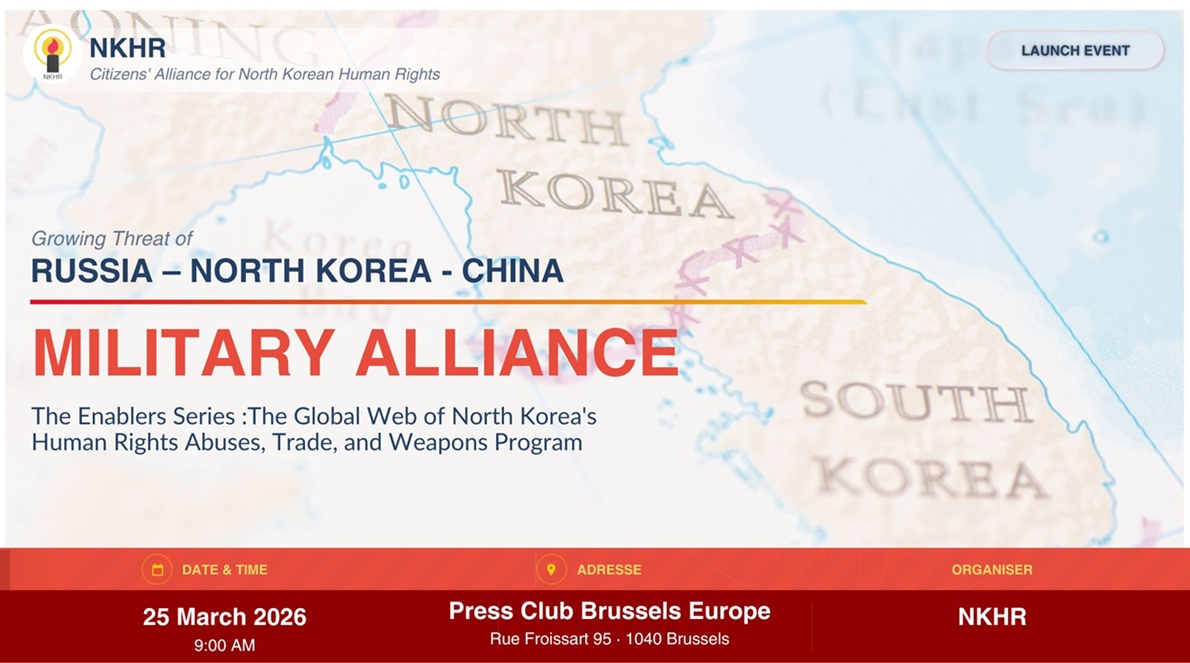
The investigation reveals how North Korean military personnel are forcibly deployed to Russia and exposes the financial system that sustains these operations. The report highlights the growing security risks arising from Russia–DPRK military cooperation, particularly within the broader geopolitical context of alignment with China.
In light of ongoing discussions within the European Union on sanctions enforcement and the implications of Russia–DPRK cooperation, the Citizens’ Alliance for North Korean Human Rights
(NKHR) is pleased to invite you to the Brussels launch of its latest investigative report in the series: “The Enablers Series: The Global Web of North Korea’s Human Rights Abuses, Trade, and
Weapons Program.”
The report examines how joint ventures and transnational networks involving Russian and North Korean military and security actors generate revenue through state-sponsored forced labour and
illicit trade structures. These operations help sustain the DPRK’s system of repression while also financing the development of its weapons programs.
Speakers:
Dr. Joanna Hosaniak, principal investigator and analyst on state-orchestrated slavery and its connection to trade and military networks and the deputy director general of the Citizens’ Alliance
for North Korean Human Rights
Mr. Ilya Shumanov, lawyer, board member of Transparency International-Russia, executive director of Arctida, and managing partner of Tritrace Investigations, specializing n investigations
in corruption, evasion of sanctions, and Russian policies in the Arctic.
Moderator:
Mr. Tomasz Sajewicz, correspondent of Polish Radio in Beijing
Speakers will be available for interviews following the event. Please contact: Hyeayoung Kang, NKHR, h.kang@nkhr.or.kr
Background Information
Over the past decade, NKHR has documented the systematic integration of crimes against humanity into North Korea’s revenue-generating architecture. Beginning with the 2020 report Blood Coal Export from North Korea: Pyramid Scheme of Earnings Maintaining Structures of Power, and continuing with Made in China: How Global Supply Chains Fuel Slavery in North Korea’s Prison Camps, NKHR has demonstrated how forced labour and enslavement are embedded within export-oriented industries designed to generate foreign currency for the regime.
These investigations established that forced labour and prison-based production operate within a
centralized chain of command directed from the highest levels of the DPRK, where military and security
organs control detention facilities to meet state-mandated foreign currency quotas.
Building on these findings, the upcoming report expands the analysis to the external enabling architecture that sustains this system. Prepared with technical support from Transparency International–Russia and the Arctida Team, the report documents how North Korean military and security-linked companies cooperate with Russian state-linked entities and private intermediaries to deploy forced labour, operate state-controlled enterprises, and channel revenue into the regime’s military and weapons programmes. Drawing on financial records, registry data, and testimony from North Korean and Russian sources, the report demonstrates how these cross-border arrangements reinforce repression while facilitating sanctions evasion and weakening regulatory oversight.
The investigation reveals how North Korean military personnel are forcibly deployed to Russia under the cover of educational or training visas issued through cooperating Russian institutions. While formally registered as students, testimonies indicate that these individuals are assigned to full-time construction and industrial labor under military command and required to meet foreign currency quotas. Financial records examined for this investigation show that Russian companies transferred billions of rubles in “scholarship” payments through intermediary educational institutions between 2023 and 2025, masking labor payments and enabling sanctions evasion. The report identifies more than one hundred DPRK-linked entities operating in Russia, including companies affiliated with military and security institutions connected to North Korea’s weapons programs.
In the context of growing Russia–DPRK military cooperation and ongoing EU efforts to strengthen sanctions enforcement, due diligence obligations, and forced labour restrictions, the findings underscore the need for coordinated scrutiny of DPRK-linked joint ventures and transnational trade networks with direct implications for European security.
Relevance for the European Union
The findings have direct implications for:
● The enforcement of EU restrictive measures concerning Russia and the DPRK
● Implementation of corporate sustainability due diligence obligations
● Forced labour import restrictions and supply-chain transparency initiatives
● The EU’s broader foreign, security, and human rights policy framework
About NKHR
Established in 1996, NKHR has been at the forefront of the advocacy leading to key UN accountabilitymechanisms concerning the DPRK, including the UN Special Rapporteur and the UN Commission of Inquiry. Through extensive documentation and engagement with international justice processes, NKHR has focused on exposing the structural links between crimes against humanity, transnational trade networks, and military financing.
Citizens’ Alliance for North Korean Human Rights (NKHR)
14F, 53 Jungcheong-ro, Seodaemun-gu, Seoul 120-012, Korea
Tel: +82-2-723-1672, 2671 Fax: +82-2-723-1671
http://www.nkhr.or.kr
e-mail: citizens.nkhr@gmail.com