
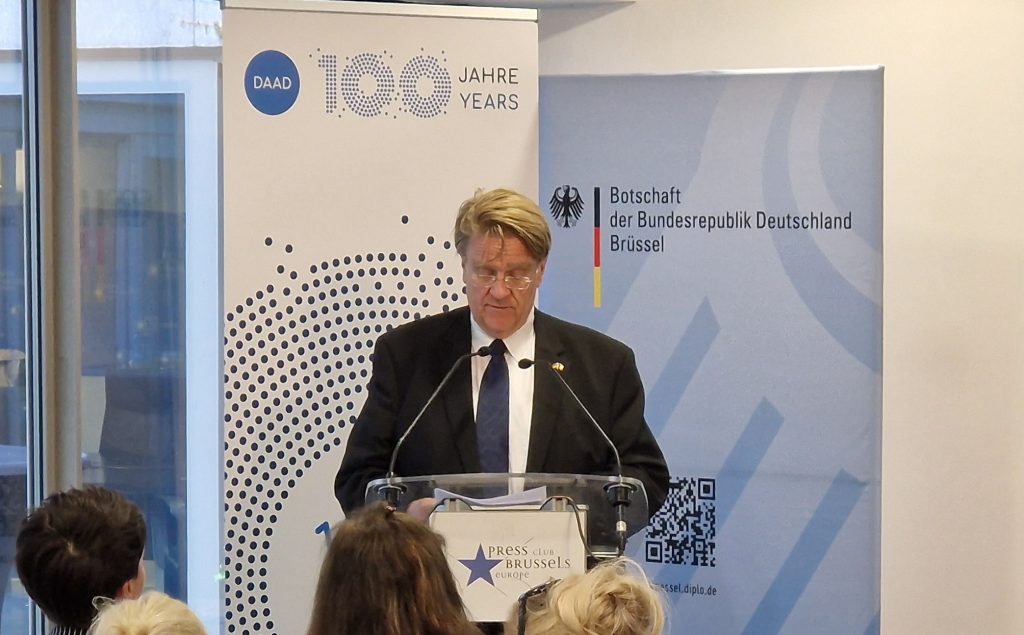
 On the 12 May, DAAD and the embassy of the federal republic of Germany in the Kingdom of Belgium invited the Brussels public to the vernissage under the theme “Celebrating Women and Diversity in Science”.
Women have made incredible contributions to science, yet they remain largely invisible and significantly underrepresented. In the EU, women represent only one third of the total number of researchers in Europe.
The unique exhibition ‘Berlin – Capital of Women Scientists’ aims to change this bias and provides a platform to showcase contemporary female scientists across various fields of research. The project was first carried out by the Berlin Institute of Health at Charité (BIH) and is part of the one-year campaign ‘Wissensstadt Berlin 2021’. Since then, the exhibition has been shown in various places around the world and is now celebrating its debut in Brussels.
With the vernissage, the organisers took the opportunity to pay tribute to women and diversity in science and at the same time learn more about inspiring personalities who are shaping this field today.
The exhibition, which is on display at the Press Club Brussels until 2 June, features portraits of 22 women scientists from the past and present. They include pioneering women who have paved the way for future generations, as well as outstanding contemporary women researchers who continue to make a difference with their work.
After welcoming speeches by H.E. Martin Kotthaus, Ambassador of the Federal Republic of Germany to the Kingdom of Belgium, and Dr Jenny Morín Nenoff, Diversity and Equal Opportunities Officer at the DAAD, Prof. Dr Theda Borde took the floor. As project manager of the ‘Empowerment for Diversity’ programme at Charité – Universitätsmedizin Berlin and keynote speaker of the evening, she presented statistics, figures and examples of the underrepresentation of women in higher education – from female students to female professors. She emphasised where political and institutional action is still urgently needed.
In the subsequent panel discussion, she spoke together with Prof Dr Sarah-Maria Fendt from KU Leuven and Adrien Braem from Science Europe on the topic of ‘Empowering Women in Science’. The focus was on concrete solutions as well as structural hurdles – such as the compatibility of family and career, insufficient childcare or the lack of female role models in science.
The central message of the evening was: talent knows no gender
« L’exposition « Berlin – capitale des femmes scientifiques » est un projet commun du Sénat de Berlin et du Berlin Institute of Health à la Charité (BIH). Dans le cadre de l’action « Berlin, ville du savoir 2021 », nous avons organisé des ateliers d’écriture Wikipédia, appelés « Edit-a-thons », avec des citoyens* intéressés, sous le patronage du maire de Berlin de l’époque, et avons conçu une exposition itinérante sur cette base. Les ateliers d’écriture avaient pour but de donner plus de visibilité aux femmes scientifiques dans Wikipédia et de rendre hommage à leurs réalisations pour le public. Dans l’exposition, les visiteurs* font la connaissance de femmes scientifiques qui ont marqué ou marquent encore de manière décisive l’enseignement, la recherche et la ville de Berlin. Plus de cent ans après que la première étudiante a pu s’inscrire officiellement, Berlin, capitale des femmes scientifiques, peut aujourd’hui se targuer d’avoir la plus forte proportion de femmes professeurs d’Allemagne et compte au total plus de 15.000 femmes scientifiques, de la doctorante à la présidente d’université. Exposition accessible au public au Press Club du 12 mai au 2 juin 2025